Observability and Monitoring
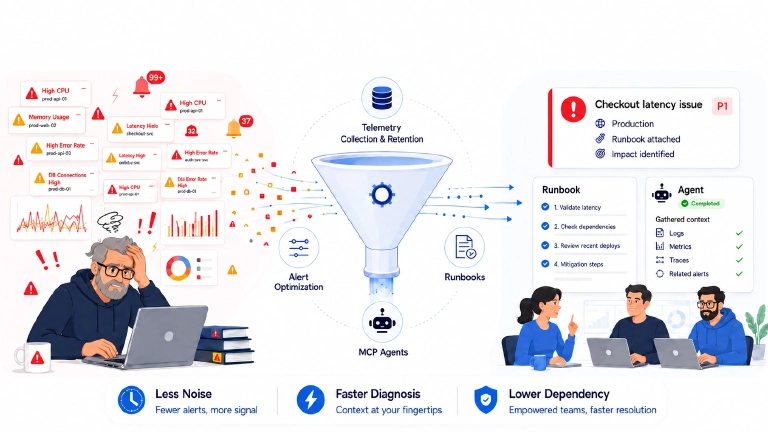
Less noise. More signal. Lower dependence on senior engineers.
Overview
Most companies already have monitoring, but setups generate noise, not insight.
Typical problems:
- too many alerts, most of them are “known” and ignored
- dashboards that look good but do not help debugging
- missing correlation between logs, metrics, and systems
- slow or late detection of real issues
The result is a monitoring stack that consumes engineering time and money without providing operational confidence.
This service focuses on building signal-driven monitoring that actually helps operate the system: actionable alerts, practical runbooks, and agent-assisted incident response..
Related use cases
Centralizing metrics and traces from remote retail sites with vmagent and OpenTelemetry
How we collected infrastructure metrics, network probes and application traces from remote POS and warehouse systems into a central Kubernetes observability stack.
RabbitMQ cluster recovery after a node outage: how insufficient monitoring resulted in a split-brain cluster
A RabbitMQ Streams incident where some writes succeeded while others failed with coordinator unavailable. How we identified the authoritative Raft state, recovered the cluster safely, and fixed the monitoring gap that allowed the split-brain condition to go unnoticed.
NGINX 502 errors from one load balancer: how a segfault caused persistent upstream failures
A load balancer kept returning 502 errors even though every backend was healthy. The root cause was an NGINX segfault during log rotation, and the long-term fix combined 5xx rate monitoring with automatic recovery from kernel-reported crashes.