all
Debugging Incident Response Root Cause

DevOps Troubleshooting | Fix Production Issues and Find Root Cause

Fix production issues, find root cause, and stabilize systems without rituals or guesswork.

Overview

When systems fail, most teams do not need more dashboards, more meetings, or more theories.

They need the issue understood, isolated, and fixed.

Production problems are expensive because they do not stay technical for long.
They turn into:

  • lost revenue
  • delivery delays
  • broken customer trust
  • team burnout
  • repeated emergency fixes that never solve the real issue

This service focuses on resolving high-impact infrastructure and delivery problems at root cause level.

Not symptom management.
Not “monitor it and see”.
Not another temporary workaround.

The goal is simple: make the system stable again and keep the same issue from coming back.

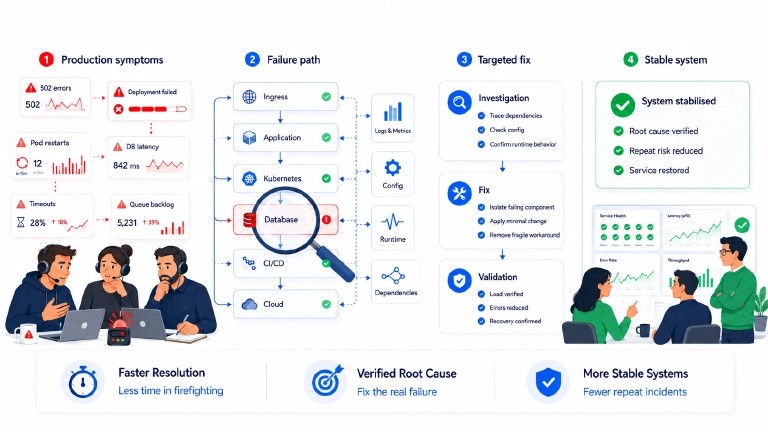
Troubleshooting illustration

Related topics

devops troubleshootingfix production issuesincident response devopsproduction debuggingroot cause analysis

Deliverables

  • Incident analysis
  • Fix implementation
  • Prevention strategy

Outcomes

  • Faster incident resolution
  • Root cause fixes
  • Reduced downtime

What this service is for

This is a good fit when:

  • production is unstable
  • the same issue keeps returning
  • incidents take too long to resolve
  • the team is firefighting instead of shipping
  • several fixes were already tried, but the problem remains
  • internal engineers are blocked by lack of time, visibility, or specialized expertise

This is especially relevant when failures affect:

  • customer-facing systems
  • deployment reliability
  • Kubernetes workloads
  • cloud infrastructure
  • databases under load
  • CI/CD and release flow

What you get

Root cause, not guesswork

  • structured investigation of the real failure path
  • dependency analysis across infrastructure, services, and delivery flow
  • validation based on logs, metrics, runtime behavior, and configuration

Fast, targeted remediation

  • minimal changes with highest impact first
  • fixes that stabilize the system before broader cleanup
  • no unnecessary rewrites or “platform transformation”

Reduced repeat incidents

  • the issue is not just patched
  • the underlying failure mode is addressed
  • high-risk weak points are identified and reduced

Clear technical conclusions

  • what failed
  • why it failed
  • what was changed
  • what still needs attention

Typical problem areas

  • Kubernetes instability
  • rollout failures and broken deployments
  • infrastructure drift and hidden configuration changes
  • cloud networking and connectivity issues
  • CI/CD failures blocking releases
  • database bottlenecks affecting production
  • resource contention, scaling failures, and noisy-neighbor effects
  • monitoring noise hiding the real incident

When this is a high-value service

This service has the most impact when:

  • the issue is already costing money
  • incidents are affecting customers or delivery
  • the internal team is overloaded
  • infrastructure has grown faster than operational discipline
  • there is no time for trial-and-error debugging

In these cases, speed and precision matter more than process.

Outcome

The issue is understood and fixed.

The system becomes more stable.

The team stops repeating the same firefight.

No rituals. No guesswork. Just a working system.

What gets fixed

  • recurring production incidents
  • random or intermittent failures
  • unstable deployments
  • failed or slow CI/CD pipelines
  • broken Kubernetes workloads
  • infrastructure misconfigurations
  • performance degradation with no clear explanation
  • systems that “work until load increases”
  • temporary fixes that became permanent

How it is done

  • define the actual problem and business impact
  • reproduce or isolate the issue where possible
  • inspect logs, metrics, events, configuration, deployment flow, and dependencies
  • test hypotheses against real behavior
  • apply the smallest fix that removes the real cause
  • verify the result under realistic conditions

No blind changes.
No “restart and hope”.
No extra complexity introduced during the fix.

Results

  • production incidents resolved faster
  • fewer repeat failures
  • lower MTTR
  • reduced operational stress
  • more predictable infrastructure behavior
  • less time wasted on workaround cycles

Engagement format

This can be delivered as:

  • urgent troubleshooting support
  • focused root cause analysis
  • production stabilization effort
  • post-incident technical cleanup
  • troubleshooting audit for recurring failures

Scope depends on urgency, system complexity, and current visibility.

Get a quote

Tell us what hurts. We’ll fix the root cause.

  • 24–48h initial response
  • one page action plan
  • measurable outcome targets

No marketing spam. Real solutions, not rituals.